About us
Who We Are
A Nigerian non-governmental organisation building the people who build Africa.
About us
Who We Are
Clintonel Foundation was founded to transform young Africans’ relationship with technology — from consumers into producers, and from job seekers into job creators.
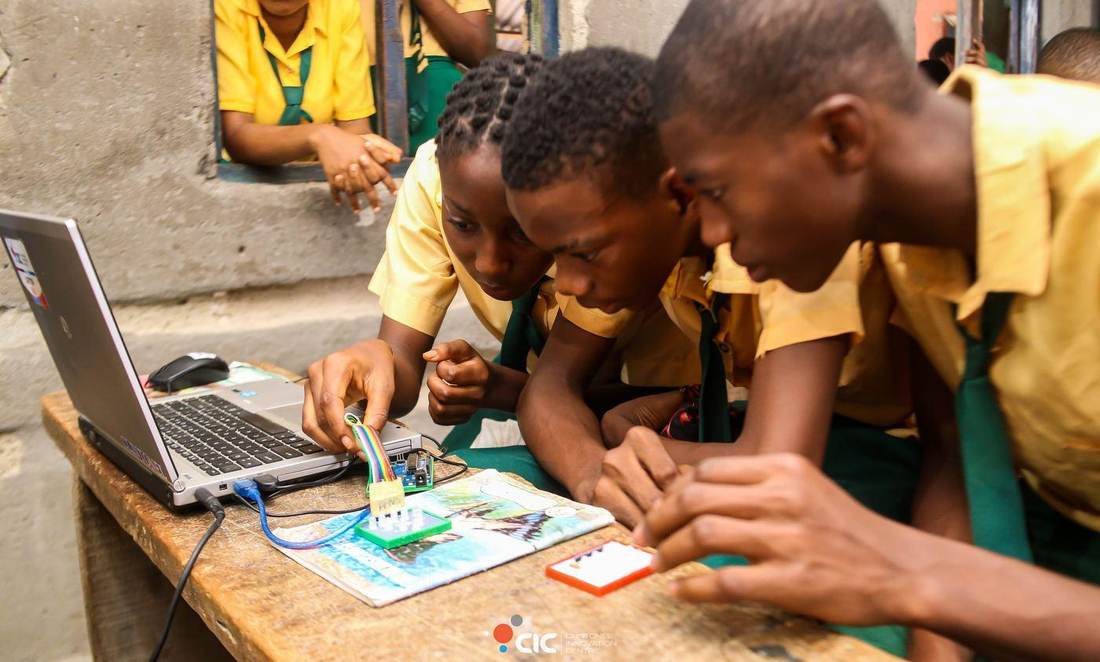
Founded in 2017 as Nigeria’s first makerspace and hardware innovation hub, the Foundation has since grown into a multi-programme ecosystem that spans secondary STEM education, university-level engineering training, youth employment, green economy innovation and technology startup incubation.
Our work is grounded in a simple conviction: Africa’s poverty is not a resource problem — it is a production problem. We exist to fix the production side, one skilled young person at a time.
Vision
To transform Africa into a technology producer.
Mission
To equip young Africans with the engineering, technical and entrepreneurial skills they need to secure dignified work, create products and build businesses.
Aligned with the UN Sustainable Development Goals
SDG 1 — No Poverty
SDG 4 — Quality Education
SDG 8 — Decent Work
SDG 9 — Industry & Innovation
SDG 11 — Sustainable Cities
SDG 13 — Climate Action
The problem
Why Clintonel Foundation Exists
Africa is the world’s youngest continent — and its most underemployed. Across Nigeria and sub-Saharan Africa, three interconnected crises are quietly compounding each other.
1. Educated but Unemployable
Millions of young Africans complete formal education without the hands-on, technical skills employers need. The result is a widening mismatch between qualification and capability — and a generation of young people for whom education has not delivered on its promise.
2. Producing Little, Importing Much
Nigeria imported goods worth ₦67.4 trillion (roughly US$45 billion) in 2025. Machinery and transport equipment is the largest import category, and manufactured goods make up about half of the import bill. Each import represents a job not created, a business not built and a skill not transferred.
Source: National Bureau of Statistics, Foreign Trade in Goods Statistics, Q4 & full-year 2025.
3. Industrialising Unsustainably
Where production does exist — in leather clusters, garment districts, light manufacturing — it often generates waste and pollution that falls hardest on the communities closest to the factory floor. Growth without environmental stewardship is not prosperity.
“These problems share a root: Africa consumes far more manufactured goods than it makes. Clintonel Foundation exists to change the ratio — by building the people who build the things.”
Our approach
Theory of Change
Our theory of change begins at the point of practical skill and traces a clear path from individual learning to continental transformation.
1
Practical Skills
Young people gain hands-on engineering, digital fabrication and entrepreneurship skills through structured training with real equipment and industry mentors.
2
Three Pathways
Skilled individuals enter employment, self-employment, or business creation — launching products and enterprises.
3
Economic Activity
More skilled workers attract industry investment. More businesses reduce import dependence and generate tax revenue and community wealth.
4
Compounding Returns
Skilled workers train others. Businesses hire and mentor. Ecosystem institutions attract further funding and policy attention.
5
Continental Impact
At scale: import substitution, export generation, poverty reduction — an Africa that makes the things it uses.
Each programme we run contributes to this pipeline — from secondary school STEM kits that build early curiosity, through university engineering competitions that sharpen technical excellence, to youth employment programmes that convert skills into livelihoods and green economy training that connects industrial development with environmental sustainability.
Governance & transparency
We Stay Accountable
Clintonel Foundation holds itself to the standards of transparency and rigour that our partners, donors and beneficiaries deserve.

Financial Accountability
Annual accounts prepared under Nigerian accounting standards and submitted to the Corporate Affairs Commission. Donor-funded programmes maintain ring-fenced accounts with dedicated reporting lines. Audited financial statements available to partners upon request.

Programme Monitoring & Evaluation
Every programme defines clear output, outcome and impact indicators before delivery begins. We track training numbers, employment transitions, business registrations, CO₂ avoided and other programme-specific metrics — and report against them honestly, including where results fell short and what we learned.

Donor Reporting
Narrative and financial reports at the intervals agreed with each partner — quarterly, six-monthly or annual. We make impact data available for independent verification and welcome site visits and third-party evaluations.

Child & Adult Safeguarding
Our safeguarding policy covers every programme participant — children and adults alike — with particular attention to the school-age children in STEM4Kids and STEM4Girls and to the young women in our mixed cohorts. All staff and facilitators are briefed on the policy before engagement.

Learning & Improvement
At the close of each programme cohort, we conduct structured reviews with participants, facilitators and employer partners. Findings directly inform the design of the next edition, ensuring our programmes remain relevant to both learner needs and labour market demands.

Corporate Governance
Clintonel Foundation is guided by an experienced Board that provides strategic direction, independent oversight and fiduciary accountability. Board members bring cross-sector expertise — spanning engineering, enterprise development, education and finance.
“Africa does not lack resources. It lacks the capacity to transform those resources into products. Clintonel Foundation is building that capacity.”
Tochukwu Clinton Chukwueke · Founder, Clintonel Foundation